So teach us to number our days, that we may apply our hearts unto wisdom.

Category: Projects

More open houses

It has been 47 days now and our house has not sold yet. We have lowered the price and are having open houses as frequently as is reasonable as long as people show up. We have tweaked everything we know how to tweak, but there are no bites yet. Just now, I just worked the verbiage that goes out onto the different websites–not sure that will help, but we will see what happens. We might have to stay here for another year. That really will not be so bad financially, but the rub is that we are really ready to get back to Texas and settle in for the long haul.

Scholarly pursuits and software

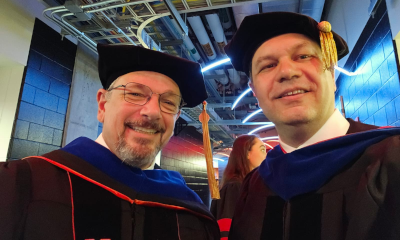
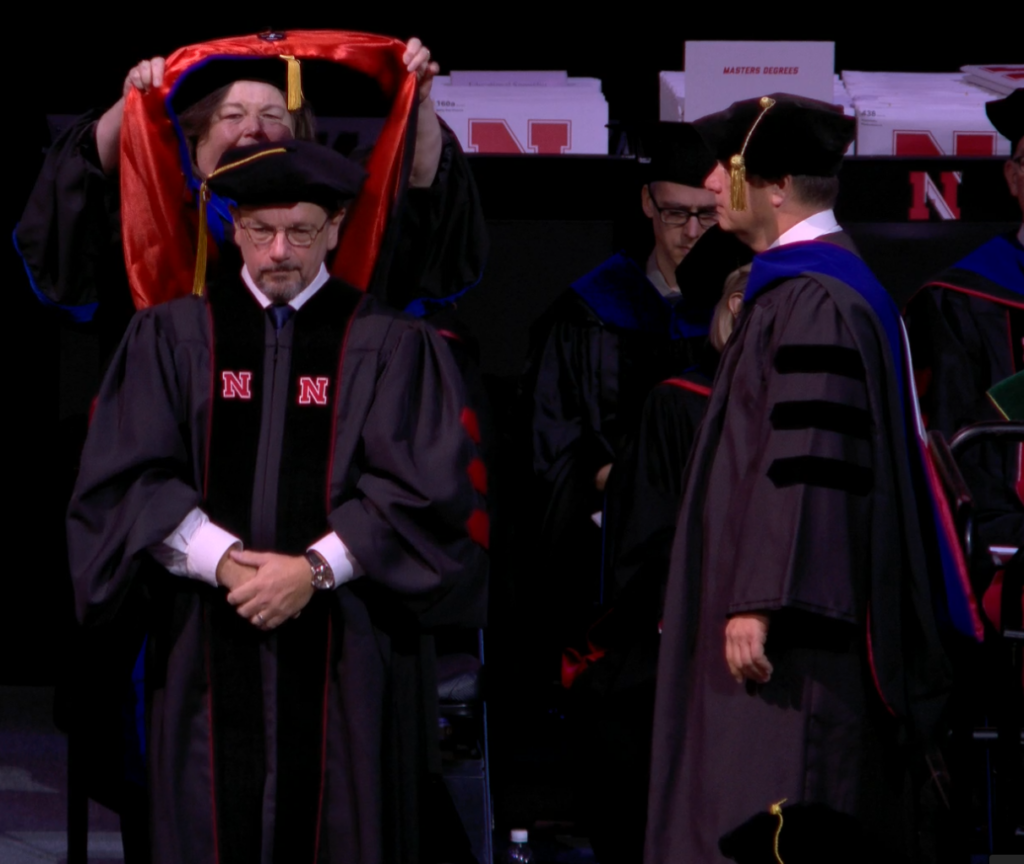
I defended my PhD dissertation in June of 2023 at age 68. Our kids flew into Lincoln, Nebraska to watch my hooding in graduation that December when I had turned 69. I thought my formal education trajectory was over at that point, but have worked consistently on GaugeCam projects and remain an adjunct professor at University of Nebraska-Lincoln since them. In addition to that, I have reached out to Tarleton State University about their Masters program in Machine Learning and Artificial Intelligence where they were amenable to my entrance there. I have decided I would like to continue contributing in these areas as long as I enjoy it, have friends with whom I can work, God is willing. In thinking about that, it dawned on me that I could go faster in the sorts of thing required for serious academic research, which is really about pushing the state of knowledge forward as measured by the production of meaningful publications, by writing research quality software rather than bullet proof, production quality software. And when I say that, I do not mean the usual trash software produced out of even the very “best” institutions for research. What I mean is software that other, non-computer scientists can use and extend easily. To that end, I just wrote a WhatsApp message to, Troy, my fellow traveler in these circles. We will see what he has to say.

Hey Troy. I am running the 800 and 8000 random images right now. I just had a thought. Why would it be a bad thing for me to quit trying to do production level robust software where the last 90% of the effort gets you 2% more functionality? My goals in all of this are to get papers published and to push the research forward in a way that benefits our work rather than production of hardened software. To that end, it kind of makes for me to aim at making the software I write profoundly more robust than typical research software, but for research ends, not production ends. Did that make any sense? That way, we are going to publish more and get further up the conditioning curve and move on to subsequent topics much more rapidly. Thoughts?

GaugeCam GRIME3 Pre-release v1.5

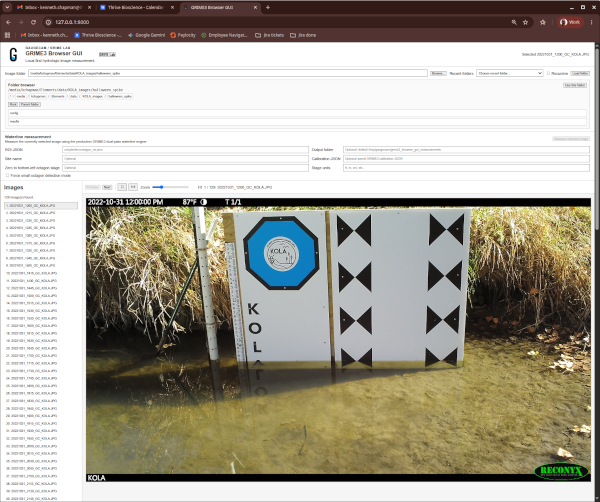
The camera-based water level measurement software upgrade from GaugeCam GRIME2 to GRIME3 hit a major milestone today today with GRIME3 Pre-release version 1.5. It is a research version, not yet ready for publication but to do the research to determine whether our new algorithms improve the precision of the water level detection in the presence of biofouling and other image degradation using a variety of both deterministic and stochastic (AI) techniques to improve the water level. I am downloading two data sets of 800 and 8000 images now and will receive a hard drive with ~30k images in the mail in a week or sot that I will run through the GRIME3 software, God willing, so we can start evaluating the numbers to see how we did.

Front of the house rendering

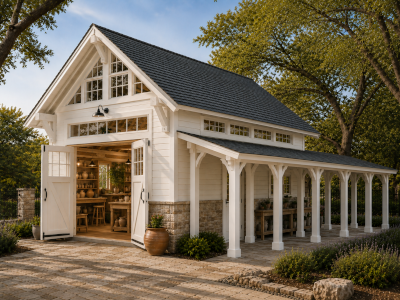
I did a pretty good render of the front of the house we want to build, God willing.

House selling requires patience

We got the report back from our house showing last Friday and from two people who came to the open house on Sunday afternoon. The people on Friday loved the house, but the living room was smaller than they expected. The two on Sunday were both work-from-home couples and were worried about the fact that all we have is StarLink for broadband internet. We were relieved that the issues were fundamentally different from the first four or five visitors who all thought the house is to close to a main road (it is not). It was a nice reminder that there are a lot of things that influence buyers over which we have no control, but that it only takes one to pull the trigger. That one is harder to find when the market conditions are not optimal with high interest rates right now. In the end, it really just takes patience. We have been very fortunate in the houses we have sold over the years, only Albany, Oregon took us longer than a couple of months and that eventually sold when we were not expecting it. So, we have decided we just need to be patient. It is all in God’s hands. We cannot start the Texas house until this house sells and that is OK. We actually love living here.

Selling the house

We are in the process of selling our house in Virginia so we can build a house on a lot we own in Texas. The design for the new house is complete along with the engineering drawings and approval from the Historic Preservation Commission of the town where we want to build. We are dying to get the house sold, but the market is not optimal right now, so we are enjoying this spectacular part of Virginia while we wait. We had a showing yesterday and a three hour open house today. That means Lorena and I have to be out of the house for an extended period time. Lorena goes out shopping and I hang out programming GaugeCam for long periods of time. I am amazed how much I am getting done and expect to be submitting two papers for publication before the end of the year. Maybe three, God willing.

GRIME3 — First prerelease

The first prerelease version of GRIME3, the Python port of GRIME2, is up and available for download on GitHub. It has almost all the functionality of the CLI version of GRIME2, but with improved waterline and octagon finding. There has already been one small feature release. I expect there will be one or two more of those before I move on to start integrating the second major prerelease version that features a GRIME AI segmentation model to help us deal with the pernicious biofouling that plagues camera based water level measurement. Testing of the first prerelease version is planned for next week in Troy Gilmore’s lab at University of Nebraska-Lincoln.

GaugeCam remote office (Panera)

I am extremely grateful for the Panera by our house. When Lorena goes shopping at Costco, Trader Joe’s, Wegman’s, Home Goods or the plethora of other stores around here, she drops me off at Panera. I drink coffee and work on GRIME3. The have a good internet connection, I love the coffee, and my favorite table is almost always available. I think it helps we are there mostly during slow hours, because I do not think it would be so good during the rush. I think about 80% of the work I have done so far on the project has been here at Panera and that percentage is rising.

GRIME3 water level measurement

My main engagement with the GaugeCam GRIME Lab these days is a port of the GRIME2 camera based water level measurement software. It was initially written in C++ as a prototype research project starting back in 2009. It morphed into production software, but has always suffered from its beginnings. It was developed on Linux using that ecosystem, but delivered only as a Windows desktop installer. It really did a great job for what it was initially intended to be, but was only adequate as a production software release.

We have wanted to make improvements to the software to handle things like biofouling at the waterline and the ability to find a much smaller target, so that was planned to be my next project. When I got my fingers back into the code to do that, I decided I was going to make this a longer term project with production code as opposed to just making the minimal fixes to make it all work just well enough to gather data and publish a couple of papers. Troy Gilmore and I have frequently discussed some of the things that would make the product better, so I decided to try to morph GRIME2 into GRIME3 with the following aims in mind:

  • Port to Python (that is where the user base is going)
  • Cross-platform compatible
    • Desktop (Linux, Windows, Apple)
    • Linux embedded (Raspberry Pi)
    • Cloud server
  • Browser based GUI
  • Extensive CLI support
  • Measurement improvements
    • Smaller calibration targets (hoping for something that fits on a standard staff gauge)
    • AI model to extract waterline in the face of biofouling

This work and corresponding publications are well under way. It is also important to note that GRIME4 is on the road map and aimed at a stretch goal and production level functionality that could have a significant impact on this niche research area.

Projects

I have worried about what I should do with myself when I retire. At seventy years old, I have to plan for projects of a more finite duration than in the past, but President Trump, with his level of vigor and age, has encouraged me to think bigger than I thought possible when I was younger. There are other criteria that become important the older I get. The purpose of this post is to provide a view of the big picture with the hope to flesh out what I am doing (and order my thoughts and plans while I go). I hope to do standalone introductory post for each one of these projects.

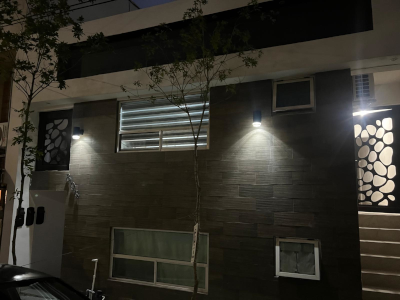
There are several things I am just going to continue as I am not the only participant. I can contribute to those projects, but they only depend on me to a limited extent and the point of my participation is to both finish well and make it so the work can continue when I am no longer there. The two main projects that fit into that category are the Mexico house project (the image above is one of our works in progress) and the GaugeCam GRIME Lab.

There are two new projects I hope to start within the next year or two for which I have taken preliminary steps. Lorena and I want to build a retirement (or maybe a non-retirement house the way things are going) in Texas that we have been designing and planning with Coker & Company for several years. We own the lot where we want to put it, the Historic Preservation Commission has approved the design, and all we need to do is get our current house sold so we can afford to build it. We hope to do some fun an interesting things both with the security and house automation system and the use of gray water that would be fun to document here.

The second short term project is a second Masters Degree. There is a program in a nearby university in Texas with whom I have been speaking about getting an MS in ML/AI. I am not 100% set on that yet–I might like to do an MS in some social science, too. Maybe God will give me time for two.

Page 3 of 3

Powered by WordPress & Theme by Anders Norén